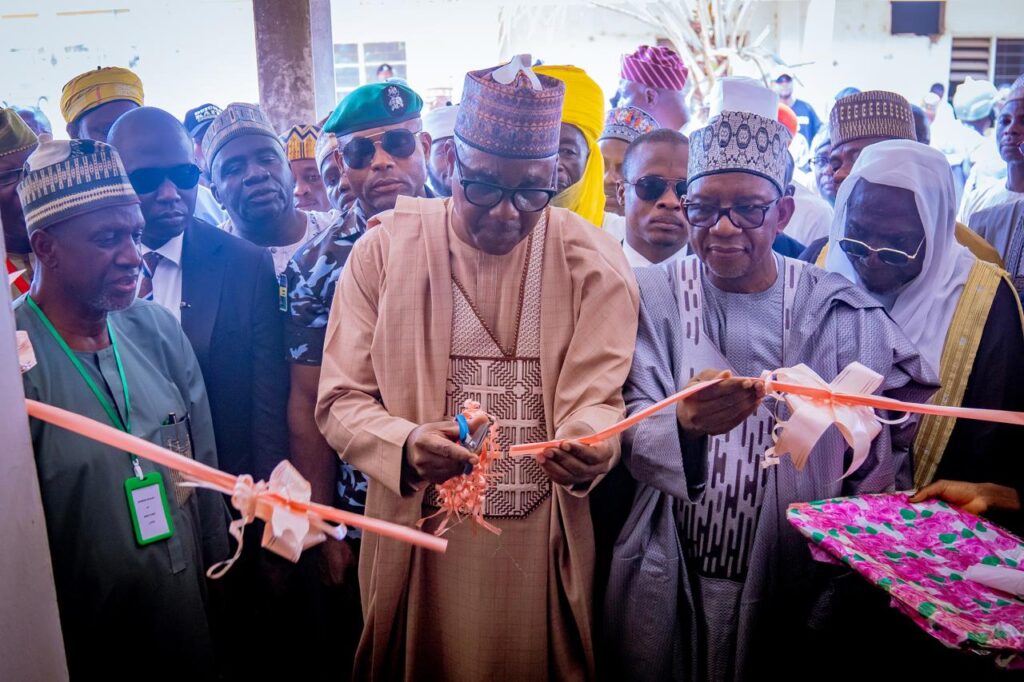

The Speaker of the House of Representatives Rt. Hon. Abbas Tajudeen, Ph.D., GCON, has reaffirmed the commitment of the 10th House to stand by every honest investor in Nigeria, stressing the need for the country to prioritise industrialisation and scale up domestic production.
 Precious Ibe
August 16, 2026
Precious Ibe
August 16, 2026
Speaker Abbas reaffirms House commitment to stand by honest investors in Nigeria
The Speaker of the House of Representatives Rt. Hon. Abbas Tajudeen, Ph.D., GCON, has reaffirmed the commitment of the 10th House to stand by every honest investor in Nigeria, stressing the need for the country to prioritise industrialisation and scale up domestic production.
Speaker Abbas also stated that the country must not only produce raw materials, especially in the agricultural sector, but also process them for local consumption, food security, and economic growth.
The Speaker stated this at the inauguration of the maize flour and maize grits plant at the Zazzau Industrial Park and Industries (ZIPI) built by Simkay Foods Limited in Zaria, Kaduna State, on Saturday.
Speaker Abbas, who lauded the initiative and massive investment by Simkay Foods Limited, stated that “a nation that cannot feed itself cannot defend itself.”
“Let me speak directly to other investors watching today. Come. Follow the example of Simkay Foods. The House of Representatives will stand behind every honest investor who bets on Nigeria.”
He said, “Why does this plant matter? Let me count the ways. The first is industrialisation. For too long, Nigeria has sold what it grows in its raw form. We grow the maize, and others grind it. We produce the crop, and others capture the profit. That must end. A nation becomes rich not by what it grows alone, but by what it makes. Every bag of flour milled here is value that stays in Nigeria. Every tonne of grits produced here is wealth that stays with our people.
“The second is food security. Maize is life in this country. It is tuwo in our homes. It is pap for our children. It is feed for our poultry and our livestock. A modern plant like this one does three things at once. It reduces waste, because harvested maize now has a ready buyer. It stabilises prices because processed food stores longer than raw grain. And it puts safe, quality food on Nigerian tables. A nation that cannot feed itself cannot defend itself. This plant is therefore not just an economic asset. It is a national security asset.”
He added, “The third is the agricultural value chain. Think of the journey of a single maize cob. A farmer plants it in the village. A trader moves it. This factory mills it. A distributor carries it. A shopkeeper sells it. A mother cooks it. That is one chain, and every link in it is a livelihood. This plant gives our farmers what they need most: a guaranteed market. When farmers know the factory will buy, they plant more. When they plant more, they earn more. When they earn more, rural poverty retreats. From farm to factory to fork, this chain carries prosperity.
“The fourth is employment. This plant will employ our people directly, on the factory floor and in its offices. But count the indirect jobs too. The farmers who will supply it. The drivers who will serve it. The mechanics, the welders, the loaders, the traders.”
Speaker Abbas pointed out that one factory feeds hundreds of households beyond its gates. “To our young people, hear me well. Jobs do not fall from the sky. They are built, brick by brick, in places like this,” he said.
The Speaker added, “The fifth is private-sector investment. Government alone cannot create the jobs Nigeria needs. No government anywhere can. The private sector builds factories, and it is the government’s duty to make building easy. That is why the People’s House passed the new tax laws that took effect in January—laws that deliberately favour manufacturers and producers. That is why we support policies that reward those who make things in Nigeria.
The sixth, Speaker Abbas stated, is northern economic development. While noting that “the North holds the largest expanse of arable land in this federation,” the Speaker stated that the region’s maize belt “can feed the nation and supply industry beyond it.”
He stated, “What we have lacked is not land or labour, but processing capacity close to the farm gate. That is changing. The North West Development Commission is now in place. The AKK gas pipeline is bringing energy for industry through our region. Roads and rail are being rebuilt. This plant joins that movement. Let it be one of many. The North must not only feed Nigeria. The North must process what it grows, and prosper by it.”
The Speaker saluted President Bola Ahmed Tinubu, GCFR, saying his reforms are restoring confidence in the economy. He also saluted the Kaduna State Government for creating the conditions that welcome investors. “When government builds the road, and the investor builds the factory, the nation moves forward,” he noted.
On the part of the legislature, Speaker Abbas gave his assurance that the House will continue to make laws that protect Nigeria’s industry. “We will oversee the agencies whose duty it is to support you. And where policy stands in the way of production, we will move it out of the way. Oversight is not optional; it is our duty to the Nigerian producer.”