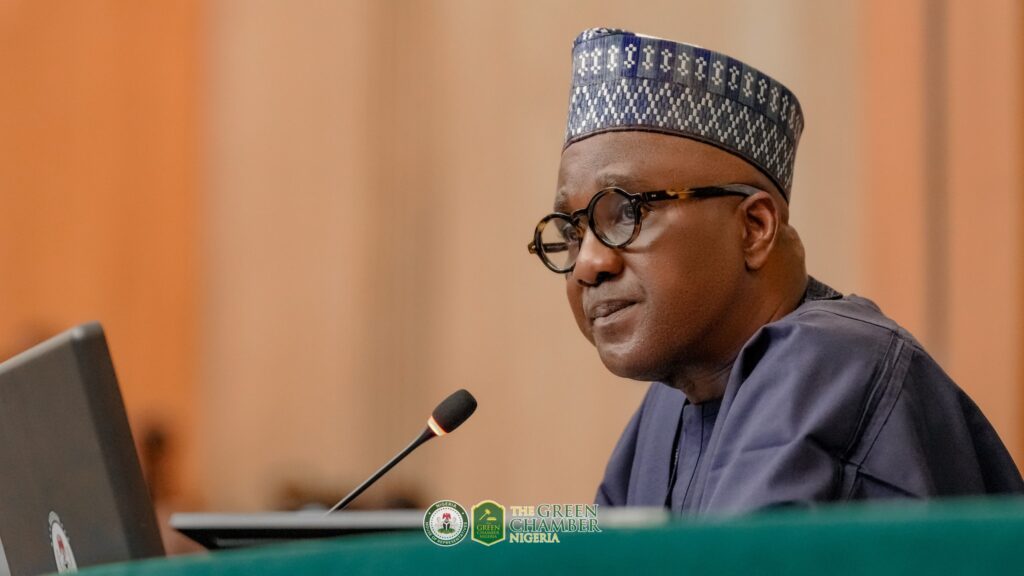

The Speaker of the House of Representatives Rt. Hon. Abbas Tajudeen, Ph.D., GCON, has stated that Nigeria can bridge the gap between the national budget and expenditure with sustained revenue generation.
 Precious Ibe
April 14, 2026
Precious Ibe
April 14, 2026
Bridging revenue gap central to fiscal stability—Speaker Abbas
The Speaker of the House of Representatives Rt. Hon. Abbas Tajudeen, Ph.D., GCON, has stated that Nigeria can bridge the gap between the national budget and expenditure with sustained revenue generation.
Speaker Abbas noted that bridging that gap through sustainable revenue is central to fiscal stability.
Giving his goodwill message at the inauguration of the Nigeria Revenue Service (NRS) Headquarters in Abuja on Tuesday, the Speaker highlighted some economic reforms caused by the current administration of President Bola Ahmed Tinubu, GCFR, especially relating to revenue generation and taxation.
Speaker Abbas pointed out that the challenge now is to sustain and deepen NRS’ performance.
He said, “This is particularly important when considering the scale of national expenditure. Nigeria’s budget has expanded significantly, with projections exceeding ₦50 trillion and rising commitments to infrastructure, security, education, and social services.
“The gap between what the nation seeks to achieve and what it currently earns remains substantial. Bridging that gap through sustainable revenue is central to fiscal stability.
“The question, therefore, is not whether revenue must increase; it is how it increases.”
The Speaker noted, “Three issues will determine that outcome. The first is consistency. Revenue administration loses credibility when outcomes depend on discretion rather than rules. The NRS must demonstrate that its processes are stable across sectors, regions, and categories of taxpayers.
“The second is visibility. A modern tax system cannot operate as a closed structure. Data, processes, and decisions must be intelligible, not only to government but to those who are subject to it. This is central to compliance.
“The third is restraint. The authority to collect revenue must be exercised with discipline. Overreach may produce immediate gains, but it weakens trust and compliance over time. These are not operational preferences. They are institutional requirements.”
Speaker Abbas said the emergence of the NRS, formerly the Federal Inland Revenue Service, must be understood within that context. “It is not only a renamed institution; it is a repositioned one, with a broader mandate and higher expectations.”
He also noted that the performance of the NRS recently has been notable. “In 2025, collections exceeded target, reaching over ₦28 trillion, with significant growth driven by non-oil revenues,” he said, adding that, “This reflects not only improved systems but also a shift towards voluntary compliance and better coordination.”
Speaker Abbas stated that institutions reveal themselves not only through laws or leadership but also through the systems they sustain over time.
While saying the building invites a different kind of reflection, the Speaker noted, “It is not simply about scale or design. It is about whether Nigeria now possesses the institutional discipline to convert authority into consistent outcomes.”
Speaker Abbas emphasised that for many years, Nigeria’s revenue system struggled less from a lack of effort than from a lack of coherence. “We operated multiple regimes, overlapping mandates, and fragmented legal frameworks. The result was predictable: high effort, low yield, and limited public confidence.”
What has changed under the Tinubu administration, the Speaker stated, is not only the policy direction but also the underlying logic of the system.
He said, “The reforms have sought to align rules, institutions, and incentives within a single framework. The 2025 Tax Reform Acts represent that shift in its clearest form. They reorganised the architecture within which revenue is generated, assessed, and enforced, and provided the basis for a more integrated system.”
To the Nigerian public, Speaker Abbas noted that it is important to address the concerns that have accompanied the reform. “Taxation is not an abstract concept. It affects daily life, enterprise, and opportunity. The intention of this new regime is not to increase hardship, but to improve structure. It seeks to broaden the base, reduce leakages, and ensure that obligations are more evenly distributed. It is also designed to protect those at the lower end of the income scale while improving collection efficiency in areas where compliance has historically been weak,” he said.
While noting the role of the National Assembly does not end with the passage of laws, as it extends to observing how those laws function in practice, the Speaker declared that the House will continue to engage the NRS through oversight, ensuring that the intent of reform is preserved in implementation.
“We are also conscious that the effectiveness of the Service will depend on its interaction with broader economic systems. The integration of technology, the expansion of the tax base, and coordination across agencies will require continued legislative attention and support,” he said.
Speaker Abbas concluded by stating that a revenue system is ultimately a relationship between the state and its citizens, as it reflects what is demanded, how it is enforced, and what is delivered in return. He added that the headquarters, in its permanence, “suggests a system that intends to endure.”
The Speaker stressed, “Endurance, however, will depend less on the structure we commission today and more on the discipline that guides its operation.”