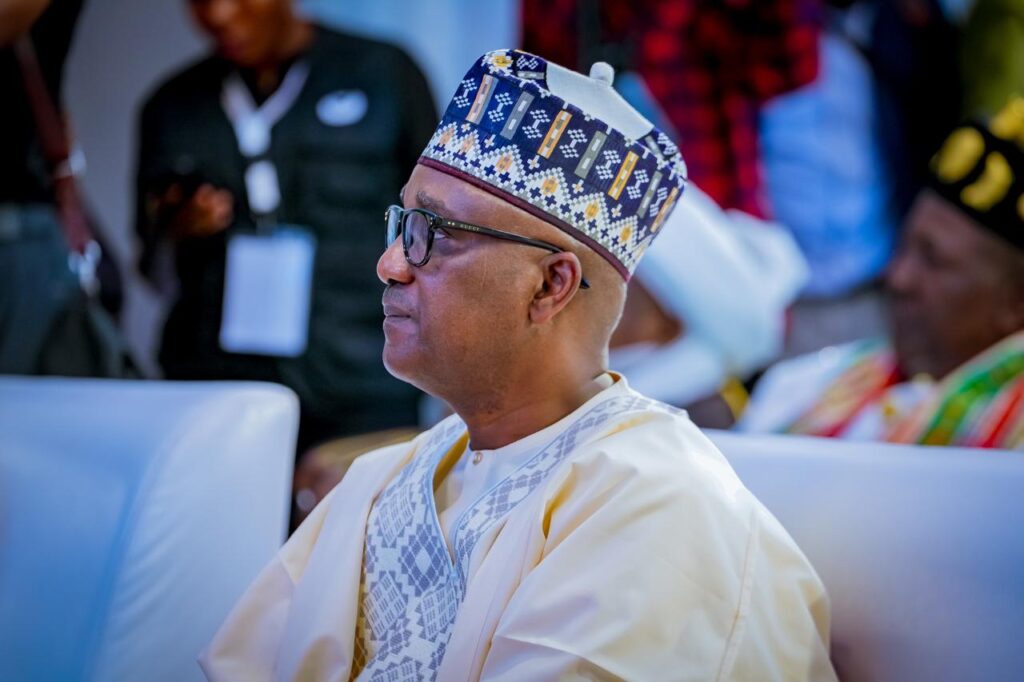

The Speaker of the House of Representatives Rt. Hon. Abbas Tajudeen, Ph.D., GCON, has suggested measures to be put in place for the actualisation of a better decentralised police structure in Nigeria.
 Precious Ibe
July 15, 2026
Speaker Abbas suggests ways to have better state police
…as House moves to strengthen President Tinubu’s police decentralisation move
The Speaker of the House of Representatives Rt. Hon. Abbas Tajudeen, Ph.D., GCON, has suggested measures to be put in place for the actualisation of a better decentralised police structure in Nigeria.
While commending President Bola Ahmed Tinubu, GCFR, for leading the move to decentralise the current Nigeria Police Force and create state police, Speaker Abbas suggested that standards be set before creating the structures.
His suggestions concern minimum policing standards, phased creation of police across states, and funding options before establishment.
The Speaker made the suggestions at the National Assembly on Wednesday in his address at the National Security Roundtable session as part of the NASS Open Week 2026.
After listing out the proposed measures to curtail abuse of state police, as contained in the executive bill forwarded to the National Assembly by President Tinubu, the Speaker noted that “our security is much larger than any single law.”
Speaking on how best to operationalise the proposed state policing system, Speaker Abbas offered three thoughts.
He said, “First, the National Minimum Standards Act must come before the first state police issue a single directive: standards first, structures after. Second, we should move step-by-step, state-by-state, learning as Germany and Canada learned, rather than switching on 36 new forces on the same day.
“Third, we must settle the question of money from the very beginning, whether through a dedicated policing fund, through shared services, or through federal support that is tied firmly to standards, so that no state creates a police force it cannot pay, and no unpaid officer becomes a threat to the citizen he has sworn to protect.”
Speaker Abbas, who noted that “for the first time in our history, a sitting President has made state police a central part of national reform,” said President Tinubu has done so not with words alone, but with a bill that now sits before the National Assembly.
He said, “Let me begin with a word of appreciation, because it is deserved. President Bola Ahmed Tinubu, GCFR, has done what many leaders talked about for 30 years, but few dared to attempt. He has sent this Parliament an Executive Bill to amend the Constitution and to allow for State Police Services. It takes conviction to bring the most sensitive question in our federation before the whole country, and it takes humility to place that question in the hands of the legislature and the people. For that, this House thanks him.
“I also thank the men and women who keep us safe while we debate: our Armed Forces, our Police, and other security and intelligence services. Many of them have lost their lives doing this work. We owe them our gratitude, and we owe them a system that serves them better than the one they have now.”
While noting that the National Assembly has funded security agencies year after year, and it will continue to do so, the Speaker stated that “money by itself is not a strategy.”
He said, “We must legislate for a modern, shared criminal and biometric database so that a suspect known in one state is not a stranger in the next. We must connect our agencies into one network of intelligence so that they work together instead of apart.
“We must build, in law, the architecture for inter-agency coordination and intelligence-sharing. We must legislate for technology, safe schools, border security, and the welfare and equipment of the officer at the checkpoint. And we must use our oversight to ensure accountability at all times.”
The Speaker, who noted that the argument for a state police is simple, said, “A country as large and as varied as ours cannot be policed forever by one central force run from the capital. More than 200 million people live across our forests, our farmlands, and our borders, and a single force cannot know every community or watch every road.”
Speaker Abbas added that local security problems need local knowledge, local presence, and local accountability. He stressed that policing works best when the people who protect a community actually belong to it, and that is the confidence this reform is meant to rebuild.
The Speaker said he understands the “reasonable” concerns of many people in the state police discourse, especially the fears that police could become the private army of a governor or a political godfather.
He said, “The people who drafted this bill had the same fears, and they answered it. A state appoints its Commissioner of Police on the recommendation of the National Police Council. The State Assembly must confirm that appointment, and only a two-thirds majority of the Assembly can remove the officer, and, even then, only for good cause.
“If a state police breaks down, or falls into the wrong hands, or turns against the very people it should protect, the Constitution allows the federal police to step in. But it allows this only in defined situations, only in writing, only for a limited period, with notice to the governor and to the National Assembly within 48 hours, and always subject to the courts.
“No such step may dissolve a state police or suspend a state’s elected institutions. These are the safeguards that will keep the reform honest.”
Citing the examples of Germany, Canada, and the United States and how the countries decentralised their police structures, Speaker Abbas called for a proper study of their models and how the systems can work for Nigeria.
“From all of these examples, one lesson keeps returning. Local policing succeeds only where national standards, shared information, and firm accountability hold it together. Where those are missing, a police force can become a danger to the very people it was created to protect. Let us take what is strong in these models, and let us avoid what has failed in them,” he said.
The panelists for the security roundtable included the governor of Kaduna State, Senator Uba Sani, CON; Chairman, House Committee on Defence, Hon. Babajimi Benson; Maj. Gen. Pat Akem (rtd.), Brig. Gen. Sani Usman (rtd.); Mrs. Moji Makanjuola, MFR, among others.